

Imagine you are a flowering plant. One day, you are suddenly turned upside down, and your flowers are submerged in a solution full of bacteria. What would your first reaction be? Probably not, “Great, I’m ready to be genetically modified.” Instead, you would instinctively trigger an alarm and prepare to defend against invasion. In the laboratory, however, this scenario happens almost every day.
Plant genetic engineering is often described as “rewriting the code of life.” Ideally, once new DNA is introduced, the plant will simply follow the designed instructions. But plants are not passive materials waiting to be modified. Living in microbe-rich environments, they have evolved highly sensitive immune systems, along with tightly regulated developmental programs.
One of the most widely used tools in plant biotechnology is Agrobacterium, a soil bacterium that naturally transfers its DNA into plant cells, causing tumors and enabling its own proliferation. Scientists have repurposed this ability, turning Agrobacterium into a gene delivery system. In the model plant Arabidopsis thaliana, this has led to the development of the floral dip method, where plants about to flower are immersed in an Agrobacterium suspension, and transgenic progeny can be selected from seeds a few weeks later.
While the procedure appears straightforward, from the plant’s perspective, it is an invasion. Plant cells possess an immune receptor called EFR (EF-Tu receptor) that recognizes the bacterial protein EF-Tu. Once detected, the plant rapidly activates immune responses, which can interfere with Agrobacterium activity and subsequent transgene expression.
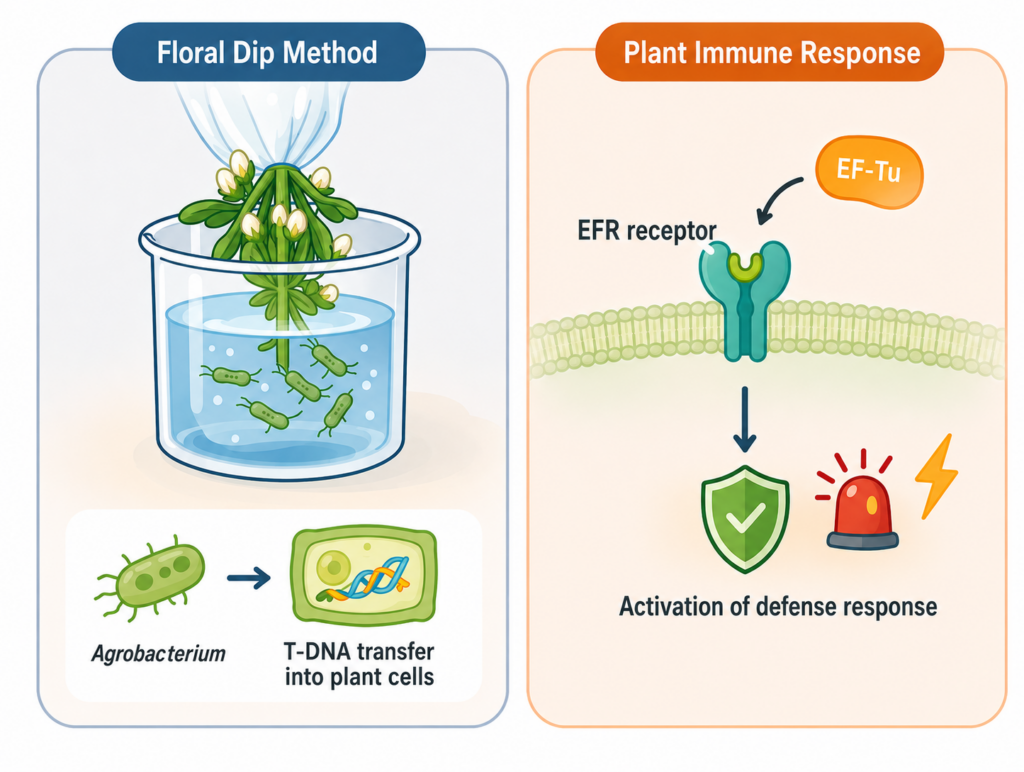
In other words, when we try to introduce new genes into plants, they are not quietly waiting to be rewritten. Instead, they actively respond. This makes genetic engineering more complex: it is not just about “putting DNA in,” but about understanding plant responses and working in harmony with their biological rhythms. The better we understand how plants function, the higher the chance of success.

The Critical Sixth Day
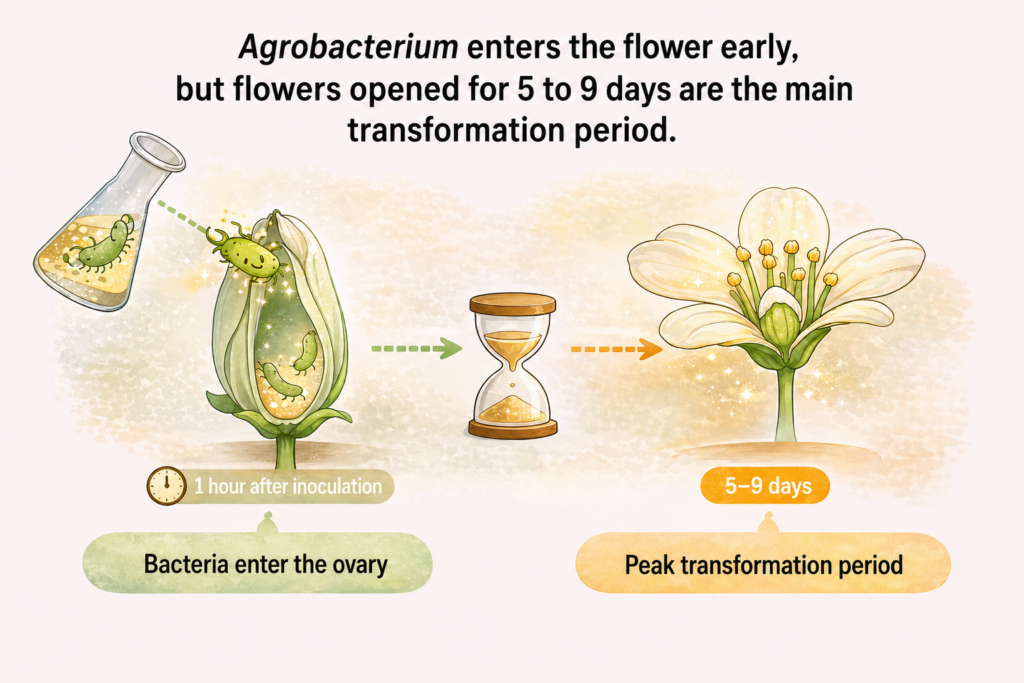
Successful transformation does not occur uniformly over time. A key factor lies in the developmental stage of the flower. Flowers are dynamic systems. Ovules mature over time, and egg cells progress through distinct developmental stages. These changes are subtle but crucial. They determine whether foreign DNA can be transmitted to the next generation. If Agrobacterium arrives too early, the ovary may not yet be fully developed, reducing the chance of successful entry and transformation. If it arrives too late, floral structures may already be fully formed, limiting access. Timing, therefore, is critical.
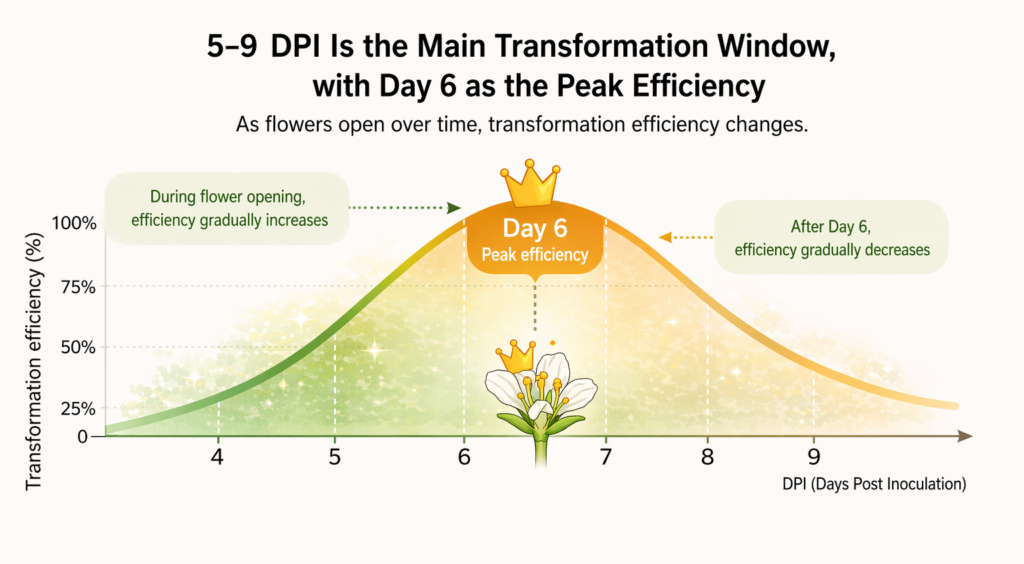
A recent study led by Drs. Erh-Min Lai, Chih-Horng Kuo and Chih-Hang Wu at the Institute of Plant and Microbial Biology, Academia Sinica, revealed that flowers opening at 5–9 days post inoculation (DPI) represent the main window for successful transformation. Transformation efficiency peaks at day 6, when nearly all siliques contain transformed progeny, reaching up to 26% efficiency. This time window is extremely narrow. Missing it by just a few days leads to a sharp drop in efficiency. In this sense, successful genetic engineering is partly about precise timing. Flowers follow their own developmental clock, and even the most sophisticated tools may fail if applied at the wrong moment. Sometimes, success depends simply on acting when the plant is “ready.”
Higher Success, Higher Cost?
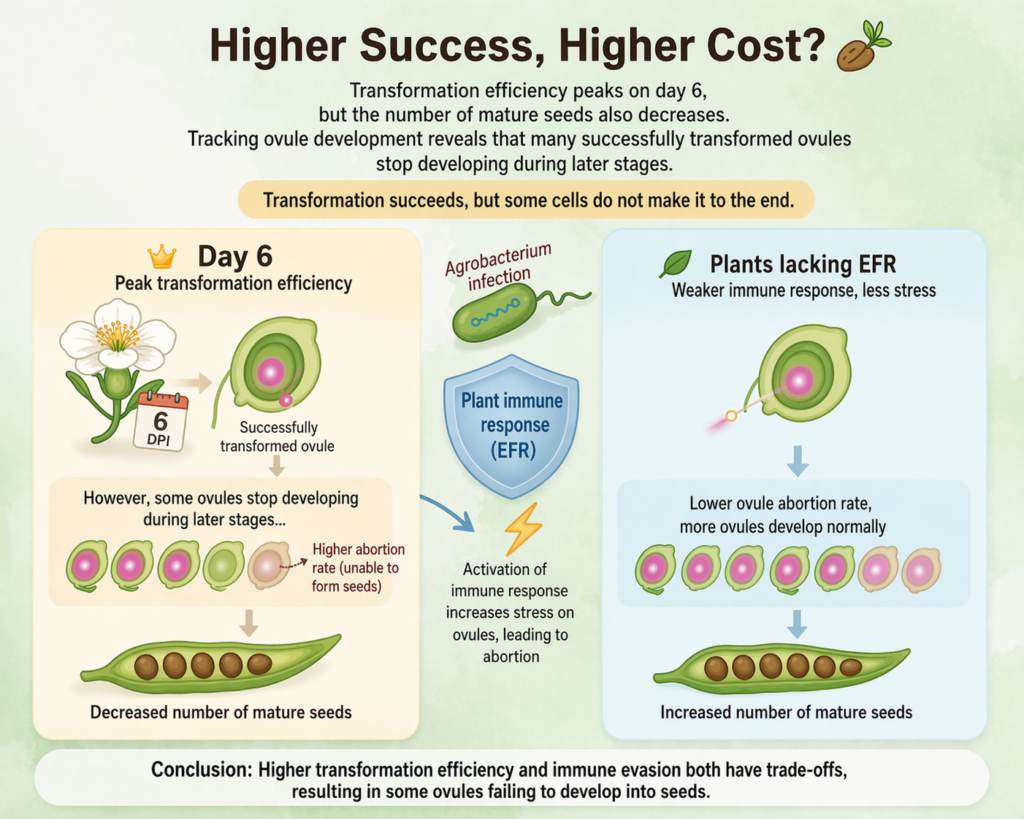
Interestingly, when transformation efficiency peaks on day 6, another phenomenon emerges: the number of mature seeds decreases. By tracking ovule development, researchers found that many successfully transformed ovules later arrest development and fail to become mature seeds. In other words, transformation occurs, but some cells do not survive to the end. Why would successful genetic modification lead to developmental failure? The answer lies in the plant immune system.
When plant EFR detects Agrobacterium, it activates defense responses. While this system evolved to combat pathogens, in the context of transformation it can impose stress on developing reproductive tissues, including ovules. In plants lacking EFR, immune responses are weaker. As a result, ovule abortion rates decrease and more seeds mature successfully. This indicates that immune activation contributes to developmental defects during transformation.
Thus, while transformation efficiency is highest at day 6, the combined effects of infection and immune responses also increase the likelihood that some ovules fail to develop properly.
“Transformation” Is Not the Same as “Editing”
The influence of the immune system extends beyond seed production. It also affects genome editing efficiency. “Transformation” and “genome editing” refer to different processes:
Genome editing: whether the target DNA sequence is actually modified
The study found that in plants lacking EFR, stable transformation rates do not significantly increase, but transient expression and genome editing efficiency is markedly improved. This suggests that immune responses do not primarily affect DNA integration, but rather influence the transient expression of introduced genes.
CRISPR editing tools only need to be present briefly to introduce changes in the genome. However, if immune responses rapidly suppress transgene expression, the opportunity for editing is reduced. When immune recognition is weakened, transgene expression can persist longer or at higher levels, thereby increasing editing efficiency.
Thus, the key to genome editing is not only whether DNA can “get in,” but also whether it can “stay long enough.” Furthermore, when Agrobacterium is engineered to be less recognizable by EFR, genome editing efficiency can be further enhanced, while stable transformation rates remain largely unchanged. This reinforces the idea that plant immunity mainly affects transgene expression duration and level, rather than the efficiency of DNA delivery itself.
Understanding the Plant’s Timing
Many people assume that advances in genetic engineering come from stronger delivery systems, sharper molecular tools, or more complex designs. But this study highlights a more fundamental factor: the physiological state of the plant.
By carefully tracking flower development and Agrobacterium behavior, researchers uncovered a key insight: although bacteria enter flowers early, effective transformation only occurs when ovules reach a specific developmental stage—when the micropyle is open and receptive. Not all time points are equal, and not all cells respond the same way.
Interestingly, when the plant immune system is weakened, genome editing efficiency improves. Likewise, when Agrobacterium is modified to be less detectable, success rates increase further. These refinements help streamline what was once a labor-intensive selection process.
In the future, the most effective genetic engineering strategies may not simply rely on more powerful tools, but on knowing when to act and when to wait. Because sometimes, success does not come from doing more, but from acting at exactly the right moment.
【Reference】
Floral stage optimization and immune evasion enhance Agrobacterium-mediated genome editing in Arabidopsis
Mao-Sen Liu, Teng-Kuei Huang, Yi-Chieh Wang, Si-Chong Wang, Chih-Hang Wu, Chih-Horng Kuo, Erh-Min Lai*
New Phytologist (2025). doi:10.1111/nph.70795