
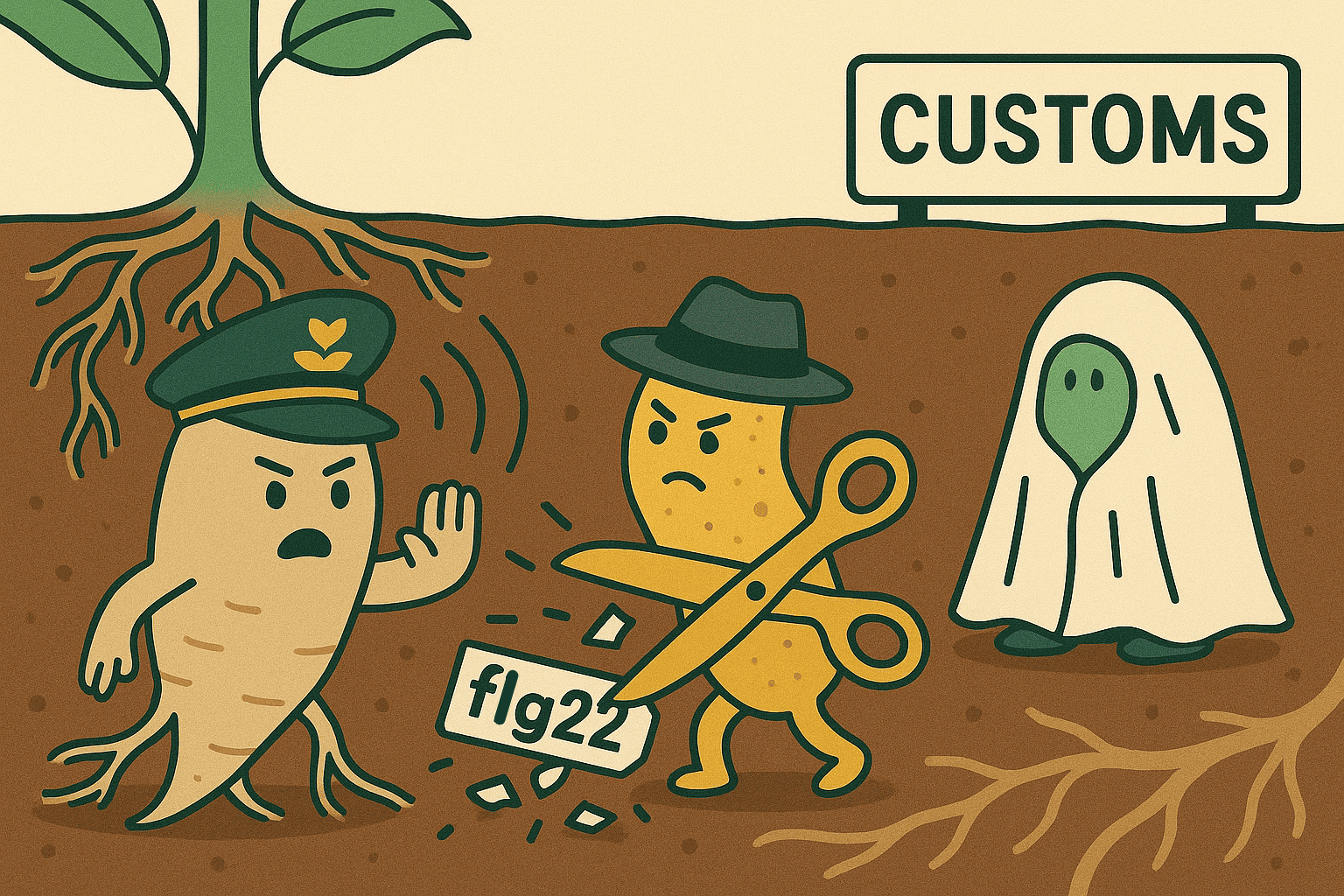
Imagine you are a spy trying to sneak through customs. The golden rule is simple: keep a low profile and avoid detection. In the plant world, missions like this play out constantly. Plants, like humans, have an immune system that detects microbes by sensing specific molecules on their surface or secreted into the surroundings. Once those cues are recognized, the system mounts a rapid defense to keep intruders out.
Among microbes, a set of skilled Xanthomonadales commensals survive by keeping a low profile, avoiding attention from the plant immune system so they can settle around roots. A recent study by Dr. Ka-Wai Ma’s lab at IPMB, Academia Sinica, in collaboration with Professor Paul Schulze-Lefert at Max Planck Institute for Plant Breeding Research, revealed their secret: these bacteria behave like well-trained spies, concealing themselves and even masking other commensals, enabling quiet residence within the plant microbiota.
The Microbial City Beneath Plant Roots
You might not realize it, but beneath every plant lies a bustling city of microbes. This underground community is especially active in the rhizosphere, which is the narrow zone surrounding plant roots where soil and roots interact most intensely. It is considered one of the most densely populated microbial habitats.
The “residents” of this city play diverse roles. Some are good neighbors: they break down organic matter in the soil, releasing nitrogen, phosphorus, and other nutrients that plants need for growth; others help roots grow and develop; still others produce antibiotics or form protective films that shield plants from harmful invaders. These supportive microbes are known as beneficial microbes. But not all residents are friendly. Some microbes secrete toxins, attack plant cells, and cause disease, posing real threats to plant health. With such a mixed community of allies and adversaries, plants must stay on constant alert, carefully distinguishing which microbes are trustworthy neighbors and which ones must be pushed away.
Although microbial communities vary with soil and climate, certain “permanent residents” consistently appear across environments. These are known as the core microbiota, and Xanthomonadales is one of their important and widespread representatives.
For plants, telling apart friend from foe is no simple task. Unlike animals, they lack eyes or noses to recognize microbes. Instead, plants rely on an innate immune radar (pattern-recognition receptors, PRRs) that scans for molecular identity tags. These tags fall into two main categories: MAMPs (microbe-associated molecular patterns) from microbes, and DAMPs (damage-associated molecular patterns) released from the plant’s own injured tissues. Once these signals are detected, the immune system is triggered, launching a strong defense response.
Masters of Disguise: How Bacteria Sneak Through the Plant’s “Customs Check”?
Imagine if bacteria acted like undercover agents, skilled at concealing their identities or hiding their passports. In such cases, the plant’s immune radar can be fooled, mistaking a potential threat for a harmless neighbor and letting it slip through. This is exactly the tactic used by certain Xanthomonadales commensals. To secure long-term residence in plant roots, researchers found that these bacteria have evolved two ingenious strategies that help them evade the plant’s immune surveillance.
1. The Invisible Scissors — Immune Evasion via Peptidases
These bacteria secrete peptidases (a type of hydrolytic enzyme) that act like invisible scissors, trimming away immune-triggering molecules such as flg22, elf18, and AtPep1. With these “alarm wires” clipped, the bacteria become much harder for the plant to recognize. Remarkably, the same enzymes can also protect nearby microbes, wrapping the group in a Harry Potter–style invisibility cloak that lets them evade the plant’s immune system.
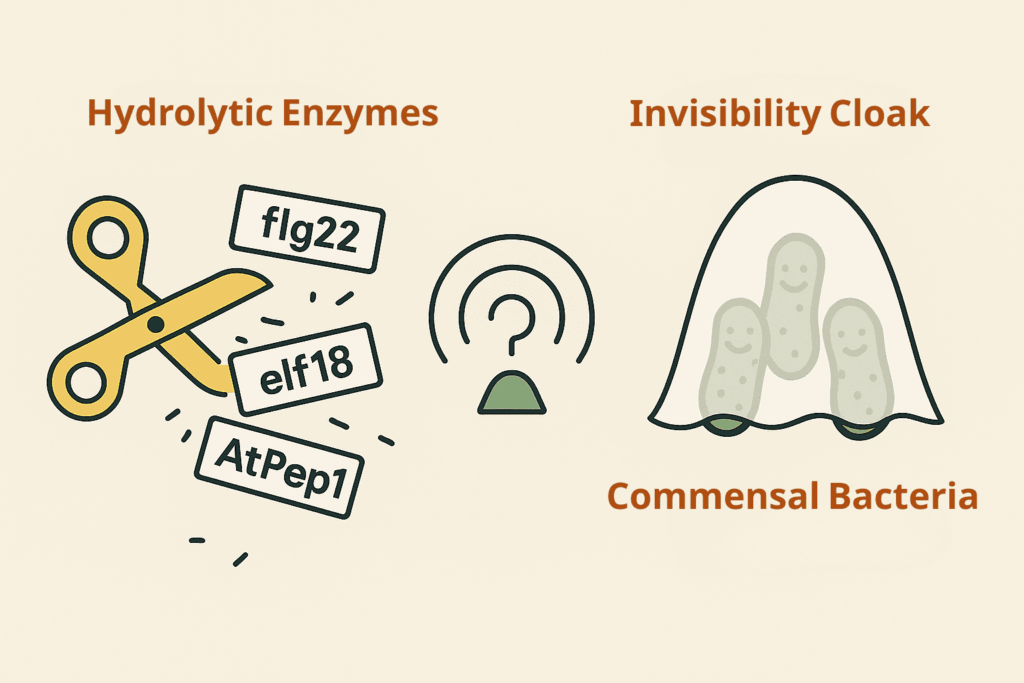
Peptidase “scissors” cut immune alarm signals (flg22, elf18, AtPep1), blurring identity and shielding neighbors, like an invisibility cloak.
2. Knocking Out Customs — Immune Suppression via dssAB
When evasion isn’t enough, some strains switch to a stronger tactic: temporarily paralyzing the plant’s immune system. Researchers identified two key genes, dssA and dssB, which encode proteins that can disrupt the transmission of immune signals. Functionally, it’s like knocking out the customs officer so the checkpoint fails. When these genes are disabled, bacteria lose much of their ability to suppress plant immunity and also lose their competitive edge in multi-species communities.

The dssA and dssB genes allow bacteria to suppress immune signaling, briefly knocking out the plant’s defenses.
When Friendly Neighbors Play Tricks
Symbiotic neighbors aren’t always harmless. Some Xanthomonadales commensals don’t damage plants immediately, yet by weakening the plant’s first line of immune defense, known as PTI (pattern-triggered immunity), they may leave plants less prepared for true pathogens. In the short term, the host looks healthy; over time, this weakening can give pathogens an opening, especially under stress. Next time you see a healthy plant, consider what might be happening belowground: microbes in camouflage, quietly reshaping the plant’s immune fate.
Next time you see a healthy plant, consider what might be happening belowground: microbes in camouflage, quietly reshaping the plant’s immune fate.
[Source]
1. Jana Ordon, Elke Logemann, Louis-Philippe Maier, Tak Lee, Eik Dahms, Anniek Oosterwijk, Jose Flores-Uribe, Shingo Miyauchi, Lucas Paoli, Sara Christina Stolze, Hirofumi Nakagami, Georg Felix, Ruben Garrido-Oter, Ka-Wai Ma & Paul Schulze-Lefert (2025) Conserved immunomodulation and variation in host association by Xanthomonadales commensals in Arabidopsis root microbiota. Nature Plants.
https://www.nature.com/articles/s41477-025-01918-w
2. Samuel Eastman, Ting Jiang, Kaeli Ficco, Chao Liao, Britley Jones, Sarina Wen, Yvette Olivas Biddle, Aya Eyceoz, Ilya Yatsishin, Todd A. Naumann, Jonathan M. Conway (2024) A type II secreted subtilase from commensal rhizobacteria cleaves immune elicitor peptides and suppresses flg22-induced immune activation
https://www.sciencedirect.com/science/article/pii/S2211124724014141?via%3Dihub